



Chinese Kite Display at Fano 2023
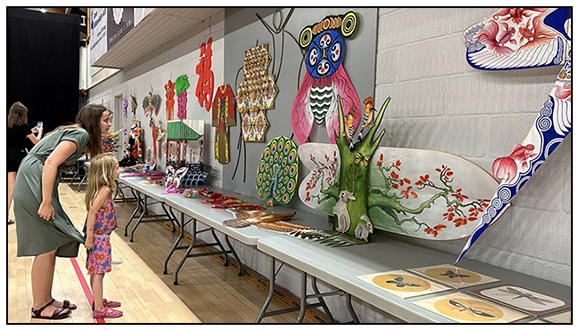 Display of Chinese Kites at Fano Kite Festival - 2023
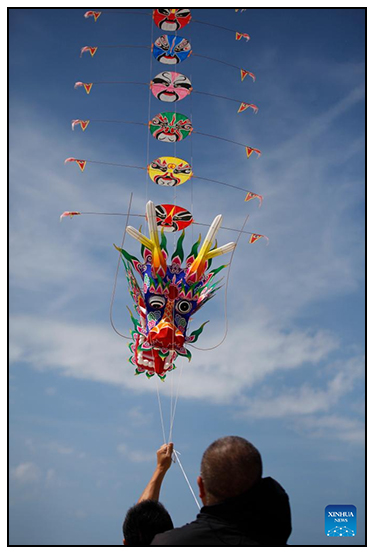 Famous Chinese Dragon kites are show stoppers at Fano.
 Hifliercanada
 Post a Comment
 2 References
Amazing Chinese Kite Honors Space Station and Chinese Astronauts
A specailly constructed China Space Station-themed kite flew to welcome home the three Shenzhou-13 taikonauts in Weifang, East China's Shandong Province. The kite, and exceptional work of craftsmanship, attracted wide attention on Chinese social media platforms.

The kite, 3.5 meters wide, 8 meters long with a total body-tail length of 150 meters, was completed by more than 20 kite artists over two months. Pictures of the three taikonauts, Zhai Zhigang, Wang Yaping, and Ye Guangfu, were also attached to the kite. To welcome the three heroes, the kite enacted the scene of the spaceship docking with the space station and taikonauts leaving the capsule.
This complex design really captures the appearance of the space station and simulates the docking for all observers to see. The celebratory flight took place April 17, 2022 on the date of the astronauts return to earth in China.
The rich history of kites in China, one of the world's foremost kite cultures, has been brought into the modern space age with this realistic tethered creation.


Successful crossing of the Atlantic Ocean on a kite-powered multi-hull boat
Francisco Lufhina, a kite surfer, has sussessfully completed a trans-Atlantic crossing in a kite-powered trimaran.
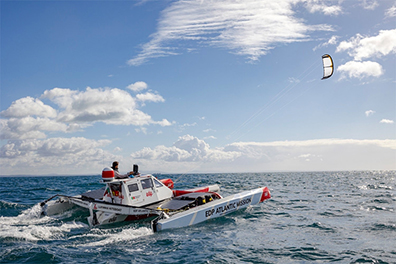
The crossing between the Canary Islands and the Caribbean took 20 days.
The Guinness World Records is expected to confirm Lufinha's fastest ever solo crossing of the Atlantic Ocean in a kite boat.
One of the Lufhina's Atlantic Mission goals, supported by a Portuguese electric utility company, was to prove that the power of wind, water, and the sun is inexhaustible.
Kites During the Pandemic
The year 2020 saw massive changes around the world in how people could go about their daily lives. The Covid19 pandemic imposed drastic changes everywhere. This also affected the world wide kite community as almost all kite festivals were cancelled.
However, as individuals, kiters were able to get out alone on kite fields and engage in their hobby.
One such kiter is Kelvin Chun of Hawaii. A dedicated kite flyer and builder of Filipino-styled kites, Kelvin took to the kite fields of the Salt Lake area of Honolulu to pass the time during the pandemic. His kite flying attracted many passersby who watched safely from a distance.

His kites and story are featured in a story, complete with video, published by Hawaii News Now on Dec. 29, 2020.
The complete story was published in the Dec. 28, 2020 edition of HawaiiNewsNow. The story features a video of Kelvin flying his Filipino-styled kites and an interview.
You can also see more in this YouTube video of Kelvin and his kites.
Canada's 'Kite Guys' - designers, builders, merchants - keep the joy of kiting alive!
Half way between Calgary and Edmonton, Alberta's two largest cities, lies the historic and bustling city of Red Deer. Just to the northwest, in the town of Bentley stands a converted church building that is the home to "The Kite Guys", a colourful and well-stocked store that supports kite enthusiasts from all across Alberta, coast to coast in Canada, and supplies kiters in the United States as well. 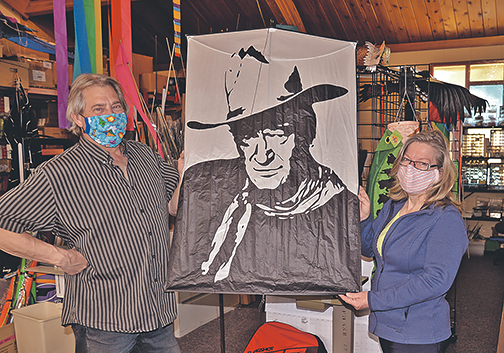
Bud Taylor and Sharon Musto - The Kite Guys in their store and studio in Bently, AB. Photo credit: Maria Johnson.
Operated by Bud Taylor and Sharon Musto, Canada's first couple of kiting, this store is filled to the brim with everything that the novice or most experienced kite flyer could wish for. It is generally regarded as the best and most comprehensive kite store in all of Canada.
Bud and Sharon are experienced kite fliers and designers. Bud started out building his own kites with his brother Scott when they were young lads. Sharon gained her introduction to the sport once she was an adult and became intrigued with kites as a form of relaxation and creative expression. Both have a wealth of knowledge and are brimming with never ending enthusiasm for sharing the joy of kite flying with novice and veteran kiters alike.
Here in this converted church building, which could now aptly be called a cathedral to kites, Sharon and Bud design many unique kites, windsocks, and flags which can be seen in the skies of Alberta and all of Canada's provinces and territories.
In 2019, the Kite Guys were commissioned to create a Canadian-made limited edition Maple Leaf Kite for the Alexander Graham Bell National Historic Site Museum Store at Baddeck, NS. This kite is available through the Museum Store's shop at the Bell National Historic Site, its website, or through the Kite Guys store and website. It flies like a dream and places the iconic red Maple Leaf proudly in the sky at the end of your line no matter where you choose to fly it.
I have known Sharon since the early days of the Internet. Kites had their own early channel for discussion on the old Internet Relay Chat system of live text dialogue. It was here that I virtually met Sharon and helped collaborate with her on the early on-line publication known as Kitelife. Sharon was the editor of the publication and I contributed a series of articles on kite history which she carefully and judiciously edited. Sharon was also the Region 13 Director of the American Kitefliers Association several years back.
Over the years we exchanged emails and she sent plans to me for a number of kites and line climbers. We never really lost touch. So, it was with great pleasure that we reunited on the Bell Museum Maple Leaf Kite project. It was on this project that I got to meet Bud and learn of his knowledge, skills, and commitment to kites as instruments of expression and joy. 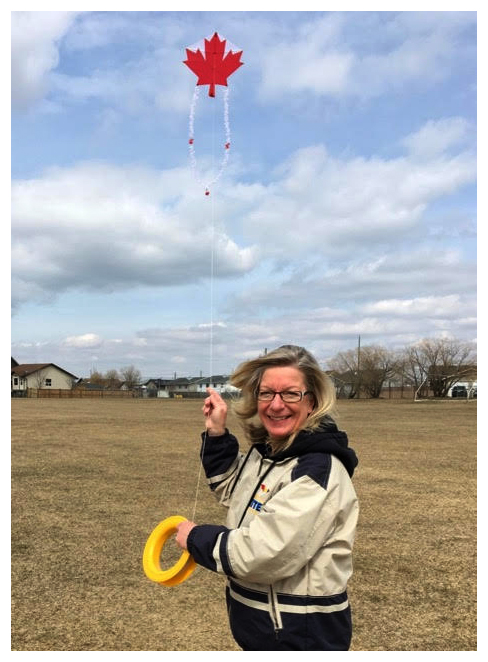
Sharon Musto flying the commisioned design Maple Leaf Kite - May 2019. Photo credit: The Kite Guys.
Bud and Sharon are well known at kite festivals in the United States and Canada and have delivered many workshops and presentations to experienced kiters who are effusive in their praise of the duo as leaders in the kite community. In talking frequently with Bud as the Maple Leaf Kite project progressed, I learned of the depth of his knowledge and his deep passion for tethered flight. He truly possesses great knowledge of kites.
In June of 2020, the Western Producer published an excellent news article with photos that gives a wonderful amount of background on Sharon and Bud and their amazing kite shop. It is well worth reading.
The Kite Guys website is filled with ideas and options for you to purchase kites which will be shipped directly to you. If you are in their neighbourhood, be sure to stop by for inspiration, wonderful conversations and the pleasure of meeting these amazing ambassadors of kites.
Photo credits: Maria Johnson, The Western Producer, June 11, 2020 in article: Go Fly a Kite -and uplifting passion -and- The Kite Guys, May 2019: Sharon Musto with commissioned design Canadian Maple Leaf Kite.

Kite History and Blog Posts by Best-Breezes Kite History is licensed under a Creative Commons Attribution 3.0 Unported License.